Mike Bass's Super Bowl VII Touchdown, Explained
A blocked kick, a loose ball and 49 yards of open field: the play that put #41 in every Washington highlight reel.
October 14, 2026 · 4 min read
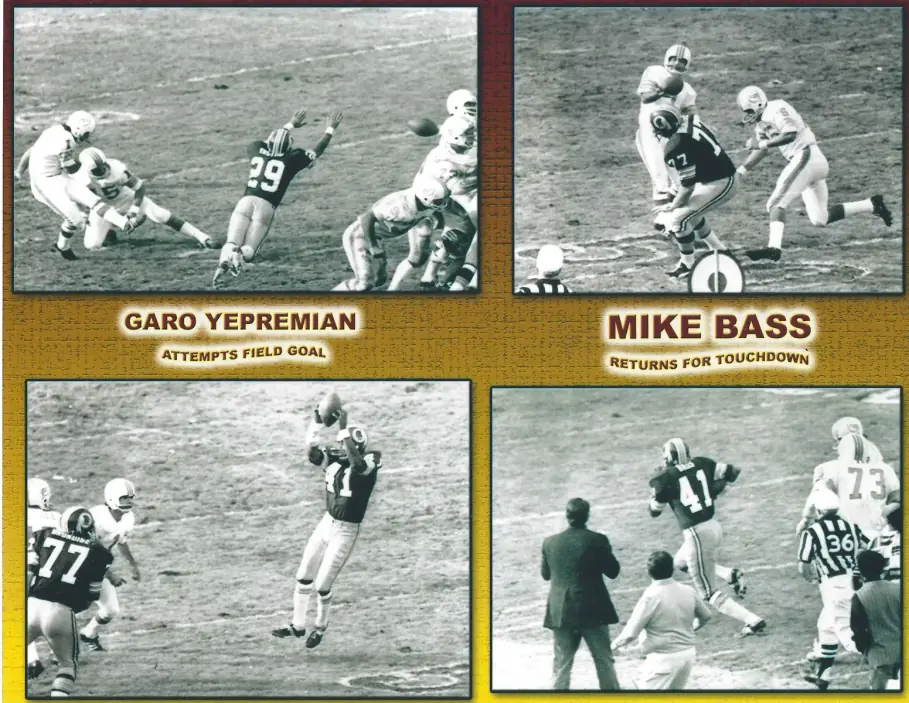
Most Washington fans can give you the outline of the play. A kick gets blocked, a kicker tries something he shouldn't, and a cornerback in a #41 jersey takes off down the field. The details are worth a slower look, because they explain why Mike Bass's touchdown in Super Bowl VII is still the first moment people bring up from that game.
Where the game stood on January 14, 1973
Super Bowl VII closed out Washington's 1972 season, and it was the first Super Bowl the franchise had ever reached. Washington finished 11-3, won the NFC East, beat Green Bay 16-3, then beat Dallas 26-3 for the conference title. Waiting on the other side was Miami, which was chasing an unbeaten season.
By the fourth quarter the Dolphins led 14-0, and Washington had not scored. That is the part people skip when they retell the play as a funny kicker mistake. Washington was behind with the clock running down. Whatever happened next had to happen quickly, and it needed a little help from the football.
The blocked field goal
Miami lined up for a 42-yard field goal that would have made it a three-score game. Washington blocked it. On a normal Sunday that's where the story ends, with a nice special teams play and a change of field position. This time the ball stayed live.
Garo Yepremian, Miami's kicker, got to it first. He could have fallen on the ball. Instead he turned and tried to throw it. The attempted pass went up into the air instead of out to a receiver, and from that moment it belonged to whoever got there first. Players who had been assigned to rush a kick or cover a return lane suddenly had a different job.
The 49 yards
Mike Bass saw the ball in the air and caught it. Then he ran. The official record has the return at 49 yards, ending in the end zone with 2:07 left in the game. A returner can't assume anything in that situation. He has to secure the ball, find the nearest threat, keep his feet moving, and trust that the field in front of him is as open as it looks. Mike did all of that over 49 yards.
It's easy to treat the play as luck, and the bounce of the ball was a gift. But the block came from his teammates, the recognition was his, and the decision to go get the ball and run with it was made in about a second. A cornerback spends a whole career learning to read where a ball is headed. In the biggest game of the year, that habit paid off.
What the score meant
The touchdown made it 14-7. It was Washington's only touchdown in Super Bowl VII, and it gave the team something real to play for: one more stop, one more possession, one more chance at a tie. For the closing minutes, the game was no longer decided.
The final score stayed 14-7, and Miami completed its perfect season. Washington lost. Fans still talk about the play more than fifty years later anyway, and it's not hard to see why. A touchdown scored when the margin for error is gone sticks in the memory longer than one scored in a blowout.
The player behind the play
Mike wasn't a visitor to big moments. He signed with Washington in 1969 and became the starting right cornerback, and he went on to play 104 consecutive games. He finished his career with 30 interceptions and 478 interception return yards. In 1974 he was named All-NFC first team and AP All-NFL second team. In 2022 Washington put him in its Ring of Fame.
That context matters for fans, because it explains why a single play from one afternoon carries so much weight. It wasn't a lucky break in a quiet career. It was the best-known moment in seven seasons of showing up, covering receivers and taking the ball away. If you want the longer run, his seasons under Vince Lombardi and George Allen are a story of their own.
Keeping the moment on the wall
For collectors, this play is the natural starting point. The "Mike & Garo" 8x10 photo is built around it, a four-panel collage of the Yepremian play and the touchdown return, and Mike signs it himself. It's $25 as an autograph-only piece and $35 with a personalized message to a named recipient, which suits a birthday, a retirement or a father who still talks about that game.
Some fans want a photo of the play itself. Others prefer a portrait or a card, and Mike signs those too. Whichever way you go, the signature is attached to a moment people actually remember, and it comes from the man who ran the 49 yards. You can see every signed photo, with the prices, on the signed photos page.
More from #41
How Personalized Signed Pieces Work
Autograph Only or Personalized Msg: what each one means, what it costs and how to choose for a gift.
Mike Bass and the Washington Ring of Fame, 2022
Number 41 takes his place beside George Allen: the 2022 induction at FedExField and what led up to it.